
On this page
- 01What is the difference between a cold room and cold storage?
- 02How are they built differently?
- 03What refrigeration does each use?
- 04How much does each cost per tonne?
- 05Which licences and subsidies apply to each?
- 06When should you choose a cold room, and when a cold storage?
- 07Can a cold room grow into a cold storage later?
- FAQFrequently asked questions
Quick answer
A cold room is a single insulated, refrigerated room of about 5 MT to a few hundred MT, built from prefabricated PUF panels with a packaged condensing unit. A cold storage is a multi-chamber facility, usually 500 MT and above, with a civil building, central refrigeration plant, ante rooms and loading docks — the scale NHB capital subsidy targets.
Key takeaways
- A cold room is a single panel-built room of about 5 MT to a few hundred MT; a cold storage is a multi-chamber facility, usually 500 MT and above.
- HyperCold's published bands fall from ₹90,000–1,50,000 per MT at 5 MT to ₹16,000–26,000 per MT at 1,000 MT.
- Cold rooms use packaged Daikin condensing units, with a standby unit on every frozen room; ammonia plants make sense above about 1,500 MT.
- NHB capital subsidy (typically 35% of eligible cost, 50% in the North-East and hilly areas) targets cold storage scale, while small rooms usually rely on AIF's 3% interest subvention or state schemes.
What is the difference between a cold room and cold storage?
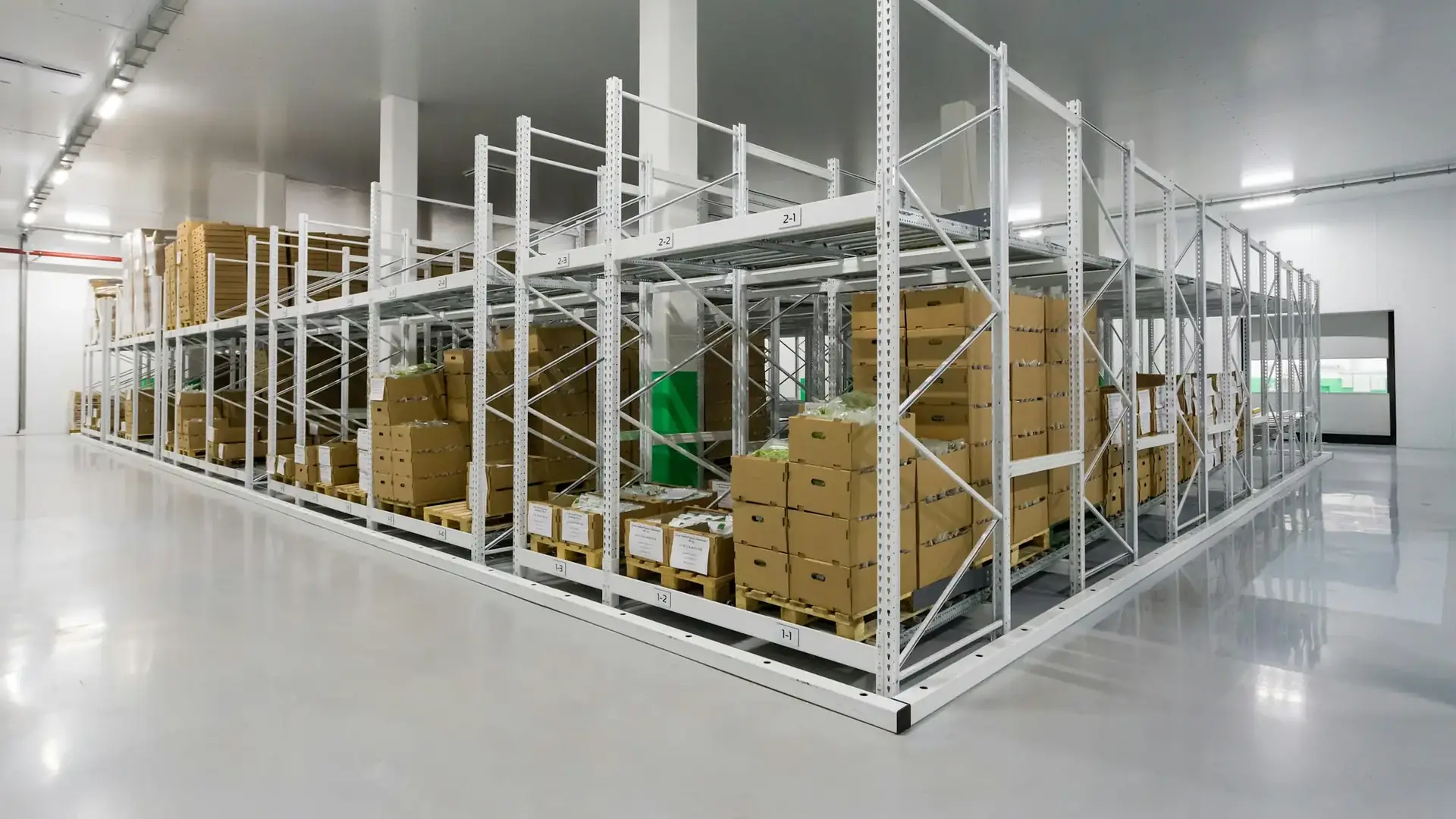
The difference is scale, and scale changes everything else — construction, refrigeration, approvals, subsidy and cost per tonne. A cold room is a single insulated, refrigerated room, from about 5 MT up to a few hundred MT, usually assembled from prefabricated PUF panels (see what is a cold room). A cold storage is a multi-chamber facility, usually 500 MT and above, with a civil building, a central refrigeration plant, ante rooms and dispatch docks.
| Factor | Cold room | Cold storage |
|---|---|---|
| Typical capacity | About 5 MT to a few hundred MT, one or a few rooms | Usually 500 MT and above, several chambers |
| Construction | Prefabricated PPGL PUF panels, 80–150 mm, on a levelled floor | RCC foundation, insulated floor, building shell, loading docks |
| Refrigeration | Packaged condensing unit + evaporator per room | Central plant with multiple compressors and redundancy |
| Temperature | One band per room, anywhere from +20 °C to −40 °C | Zones per commodity; bulk chambers often at one set point |
| Lead time | Delivery 2–4 weeks from order confirmation | 8–14 weeks from order once the civil pad is ready, plus approvals |
| Indicative cost | ₹4.5–16 lakh for 5–20 MT | ₹1.6–2.6 crore for 1,000 MT |
| Subsidy fit | AIF interest subvention, state schemes | NHB / MIDH capital subsidy; PMKSY for integrated cold chains |
In everyday Indian usage the words overlap — a trader may call a 10 MT room their 'cold storage' — but the distinction matters as soon as you talk to a bank, a subsidy agency or a licensing office.
How are they built differently?
A cold room is an equipment purchase. HyperCold supplies the PUF panels, door, Daikin refrigeration and controller and erects them on a floor you provide; foundation, flooring, drainage, water and the power connection stay in the client's scope. Panels lock together with cam-locks, so the room can later be extended, split or relocated. Rooms wider than 10 ft add an MS roof support frame, and standard designs stop at 20 ft width — beyond that you are designing a building, not a room.
A cold storage is a construction project. Civil works — RCC foundation and slab, sub-floor insulation, drainage gradients, loading docks and the external shed — are about 12–18% of capex on a 1,000 MT project, and electrical infrastructure (HT/LT line, transformer, panels, lighting, earthing) another 8–12%. Floor insulation is not optional at this scale: in north Indian summers an uninsulated floor can account for 15–22% of the total cooling load.
What refrigeration does each use?
Cold rooms use packaged split systems: a condensing unit outside and an evaporator inside. HyperCold's configurator picks the Daikin series by temperature band — HMT for +8 to +15 °C produce rooms, MT for 0 to +8 °C chillers and LT for −18 to −22 °C freezers — and the size by room volume. The FY2026-27 rate card runs from 1.5 HP to 14 HP condensing units plus 25–35 HP semi-hermetic units, and large rooms get two to eight units in parallel. Every frozen room is configured with a standby unit (for example 1 working + 1 standby), so a breakdown does not cost the stock.
Cold storages move to central plants. HyperCold's refrigerant guide puts the crossover at about 1,500 MT for general cold storage: below it, Freon systems (R32 increasingly preferred) win on capital cost; above it, ammonia (NH3) plants are more efficient but need a PESO licence for more than 50 kg of ammonia, trained operators and continuous gas detection. The trade-offs are in ammonia vs Freon.
How much does each cost per tonne?
Cost per MT falls steeply with scale, because doors, controls, machines and installation are spread over more tonnes. These are HyperCold's published indicative all-in bands for 2026; GST treatment, site conditions and scope move the final figure.
| Size | Typical format | Indicative project cost | Cost per MT |
|---|---|---|---|
| 5 MT | Single walk-in room | ₹4.5–7.5 lakh | ₹90,000–1,50,000 |
| 10 MT | Single walk-in room | ₹6.5–11 lakh | ₹65,000–1,10,000 |
| 20 MT | Single room, or 10 + 10 MT | ₹10–16 lakh | ₹50,000–80,000 |
| 50 MT | Single-room walk-in | ₹12–18 lakh | ₹24,000–36,000 |
| 200 MT | Multi-chamber cold room | ₹38–55 lakh | ₹19,000–27,500 |
| 1,000 MT | General cold storage | ₹1.6–2.6 crore | ₹16,000–26,000 |
| 5,000 MT | Bulk cold storage | ₹6.5–10 crore | ₹13,000–20,000 |
The 50 MT-plus rows assume a north Indian climate, a level civil pad and 415 V three-phase power at site; coastal, hill and sub-zero projects run 15–35% higher. For one specific room, the quotation configurator prices panels, door, Daikin machine, controller and installation from the FY2026-27 rate card: an 8 × 8 × 8 ft chiller rated at about 5.2 MT comes to about ₹2.6 lakh plus GST, before freight, civil work and optional items. All figures are indicative; the final price follows a site survey.
Which licences and subsidies apply to each?
If the product is food, the operator needs FSSAI registration or a licence whatever the size; the category follows turnover (basic registration below ₹12 lakh, state licence from ₹12 lakh to ₹20 crore, central licence above ₹20 crore; confirm against current FSSAI rules). Beyond that, the two formats sit in different worlds:
- Cold room (5–20 MT) — usually below the size NHB and MIDH capital subsidy is designed for; HyperCold's cost pages cite 30 MT as the usual starting point, and a 20 MT room combined into a 30 MT-plus facility can come within those norms. Eligible farmers, FPOs and agri-entrepreneurs can use the Agriculture Infrastructure Fund's 3% interest subvention on loans up to ₹2 crore, PMFME for micro food processing units, or state schemes.
- Cold storage (500 MT and above) — the scale NHB's credit-linked, back-ended capital subsidy is built for: typically 35% of eligible project cost in general areas and 50% in the North-East and hilly areas, released after commissioning and joint inspection. It needs a bank term loan and a subsidy-grade DPR, and a new facility also needs Fire NOC, pollution consent (CTE before construction, CTO after), building plan approval, an HT power sanction and a factory licence once 10 or more workers are employed with power.
Scheme rules and percentages change; check the current notification and read the NHB subsidy guide before planning finance around a subsidy.
When should you choose a cold room, and when a cold storage?
Choose a cold room when:
- you store your own stock — a restaurant, dairy, pharmacy, trader or FPO — rather than renting space to others;
- volume is under a few hundred MT, or you need several different temperatures in small quantities;
- you want delivery in weeks and the option to extend or relocate;
- the budget is in lakhs rather than crores.
Choose a cold storage when:
- you plan to rent capacity to many farmers or traders, as bulk potato stores do;
- a single commodity runs into thousands of MT per season;
- you can carry an 18–30 month NHB cycle from DPR to subsidy release;
- you have land, an HT power connection and staff to run a plant.
Between the two sits the modular multi-room facility: several panel rooms side by side, each at its own temperature. The configurator's common-wall option removes the shared wall panels — two 10 × 10 × 9 ft fruit-and-vegetable rooms in series need 89 m² of panel instead of 106 m², about ₹35,000 less ex-GST.
Can a cold room grow into a cold storage later?
Partly. Modular panels can be extended and new rooms added alongside, so a 10 MT room can become a 30–50 MT multi-room facility without demolition. What does not scale is the site: a true cold storage needs load-bearing civil work, dock space, a transformer-grade power connection and approvals that are far cheaper to plan on day one than to retrofit.
If a 500 MT-plus facility is the end goal, size the land, power sanction and project report for it from the start, and build the first chambers inside that plan. Starting construction before in-principle approval is the single biggest reason NHB applications are rejected, so sequence the paperwork first — HyperCold's DPR support covers the bank and subsidy documentation.
FAQ
Frequently asked questions
Is a 50 MT room a cold room or a cold storage?
By construction it is a large cold room: a single panel-built chamber with packaged refrigeration. HyperCold's cost guide prices a 50 MT single-room walk-in at an indicative ₹12–18 lakh, or ₹24,000–36,000 per MT.
Can I rent out space in a small cold room?
Yes. If the stored goods are food, the operator needs FSSAI registration or a licence even when the stock belongs to customers, and the licence category follows your turnover.
Can one cold room hold products that need different temperatures?
Not well. One room holds one set point, so use separate rooms — for example a +2 to +4 °C chiller and a −18 °C freezer — or, for mixed produce, the least sensitive common range and accept a shorter shelf life.
Do cold rooms use ammonia refrigeration?
Not normally. Packaged cold rooms use Freon-based condensing units; HyperCold's refrigerant guide reserves ammonia for general cold storage above about 1,500 MT and large industrial freezers.
Is AIF support available for a single cold room?
It can be, if the borrower is eligible (for example a farmer, FPO or agri-entrepreneur) and the room is post-harvest infrastructure. AIF gives interest subvention and credit guarantee on the bank loan, not a capital subsidy; confirm current limits in the AIF guidelines.
Written by
HyperCold Engineering Team
Cold room and cold storage engineers at HyperCold™, a Daikin equipment partner founded in 2020 and headquartered in Sirsaganj, Firozabad (UP). We design, manufacture PUF panels for, install and maintain cold rooms across India.