
On this page
- 01How does a cold room refrigeration system work?
- 02Which compressor types are used in cold rooms?
- 03What does the condensing unit do, and why does placement matter in India?
- 04How do you choose an evaporator for a chiller or a freezer?
- 05TXV or EEV: which expansion valve is better?
- 06Which defrost method suits which room?
- 07What does the cold room controller do?
- 08Which refrigerants and Daikin series does HyperCold use?
- FAQFrequently asked questions
Quick answer
A cold room refrigeration system is a vapour-compression circuit: the evaporator absorbs room heat, the compressor raises refrigerant pressure, the air-cooled condenser rejects heat outdoors and a TXV or EEV meters liquid back. HyperCold uses Daikin HMT for 80 mm produce and ante rooms, MT for 0 to +8 °C chillers and LT for −18 to −22 °C freezers.
Key takeaways
- On a 45 °C day an air-cooled condenser typically runs 10–15 K above ambient, about 55–60 °C, so condenser airflow and cleanliness decide summer capacity.
- Unit coolers for chillers use closer fins (about 4–5 mm) than freezers (about 6–7 mm) and blast freezers (about 8–12 mm), because frost bridges tight fins.
- The same 2 HP rating gives 4 kW in Daikin's MT series but 2 kW in the LT series on HyperCold's rate card, because capacity falls at low evaporating temperature.
- HyperCold's configurator routes every 100 mm chiller-type room to the MT series, because HMT units cannot hold 2–8 °C reliably, and quotes frozen rooms as working-plus-standby sets such as 1+1 or 2+1.
- Off-cycle defrost suits rooms held at about +2 °C and above; freezers need electric or hot-gas defrost and a heated drain line.
How does a cold room refrigeration system work?
Every packaged cold room system runs the same vapour-compression cycle in four steps:
- Evaporation (inside the room). Low-pressure liquid refrigerant boils in the evaporator coil and absorbs heat from room air blown across it. The coil runs about 6–10 K colder than the room, so a +4 °C chiller evaporates at roughly −2 to −6 °C.
- Compression. The compressor draws in the vapour and raises its pressure and temperature.
- Condensation (outdoors). The hot vapour gives up heat to outdoor air in the condenser coil and turns back into liquid. On a 45 °C day an air-cooled condenser typically runs 10–15 K above ambient, about 55–60 °C.
- Expansion. A thermostatic (TXV) or electronic (EEV) expansion valve drops the liquid's pressure and meters it back into the evaporator.
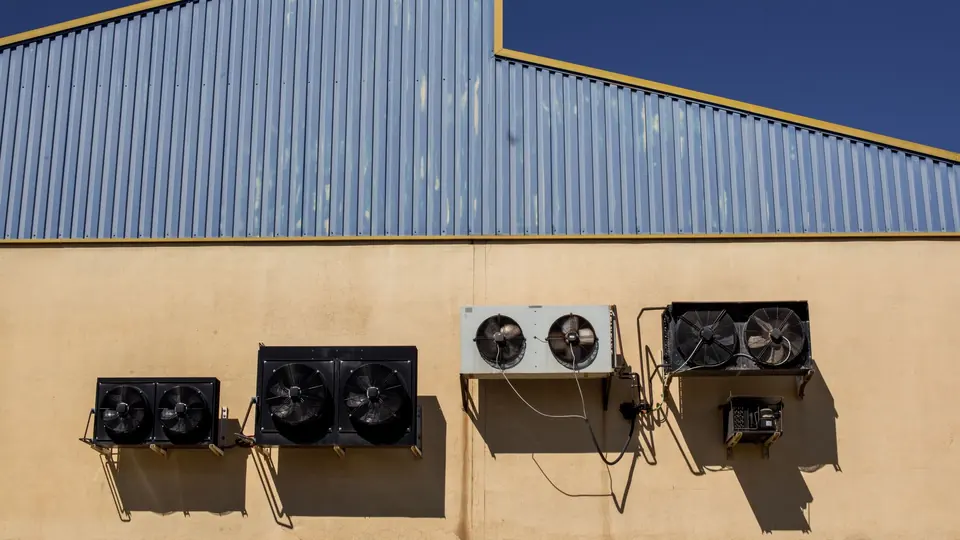
The outdoor half — compressor, condenser coil and fan, receiver, filter-drier, sight glass and pressure switches — is the condensing unit (ODU). The indoor half — coil, fans, drip tray and expansion valve — is the evaporator or unit cooler (IDU). Insulated copper piping and a controller tie them together. Both halves are sized from the room's heat load calculation, not from a TR-per-cubic-foot rule.
Which compressor types are used in cold rooms?
| Compressor | Where it fits | Strengths | Watch-outs |
|---|---|---|---|
| Hermetic reciprocating | Small chillers and freezers | Low first cost, simple | Sealed, so replaced rather than repaired; noisier than scroll |
| Scroll (fixed or inverter) | Most walk-in chillers and freezers, typically up to about 30 TR | Few moving parts, quiet, efficient; inverter versions track load | Sealed unit, replaced as a whole if it fails |
| Semi-hermetic reciprocating | Larger rooms and low-temperature duty | Bolted, field-serviceable valves and bearings | Heavier and costlier; needs oil management |
| Screw | Large cold stores and industrial plants | High capacity per machine | Industrial scale; often paired with ammonia |
HyperCold's default platform is Daikin commercial refrigeration: packaged air-cooled condensing units in the HMT, MT and LT series for most rooms, and the semi-hermetic MLR series (25–35 HP, 40–56 kW on the rate card) for the largest frozen selections. HyperCold's buying guide treats scroll machines as standard below about 30 TR, with semi-hermetic or screw machines beyond that.
What does the condensing unit do, and why does placement matter in India?
The condensing unit has to reject all the heat taken out of the room plus the compressor's own motor heat — into outdoor air that may already be 45 °C. As condensing temperature climbs, capacity falls and power draw rises, so the unit's surroundings matter as much as its rating.
Placement rules HyperCold applies:
- Keep the coil face and fan discharge unobstructed and never box the unit into a closed room; HyperCold's guidance is that a poorly ventilated location can cut cooling capacity by up to 30% and trip the high-pressure cut-out.
- Shade from direct sun helps only if it leaves the sides open and does not recirculate hot discharge air.
- Mount on a level plinth or wall bracket with anti-vibration pads and service access on the compressor side.
- Keep refrigerant pipe runs short, insulated and within the limits in the unit's installation manual.
- Clean the coil often in agricultural areas, where dust, cotton fluff and leaves clog it fast; the fault signs are in the troubleshooting guide.
How do you choose an evaporator for a chiller or a freezer?
The unit cooler must deliver the condensing unit's capacity at the room's evaporating temperature. Fin spacing, coil-to-room temperature difference (TD) and defrost decide whether it holds temperature and product quality:
| Room type | Typical fin spacing | Coil-to-room TD | Defrost |
|---|---|---|---|
| High-humidity chiller (fruit, vegetables, flowers) | about 4–5 mm | 6–8 K | Off-cycle or electric |
| General chiller (dairy, packed food, pharma) | about 4–5 mm | 8–10 K | Off-cycle or electric |
| Freezer, −18 to −25 °C | about 6–7 mm | 8–10 K | Electric or hot gas |
| Blast freezer, −30 to −40 °C | about 8–12 mm | Set by pull-down time | Electric or hot gas |
Wider fins in freezers stop frost bridging the gaps and choking airflow between defrosts. A smaller TD keeps humidity high and cuts weight loss from produce, at the cost of a larger coil. Air throw must reach the far wall over the stack, so never let pallets block the evaporator face.
On HyperCold quotations the Daikin unit-cooler code shows its series: H or HM for HMT, M for MT and L for LT. CRE2M800ASV16, for example, is an MT cooler of roughly 8 kW, and B-series models such as CRE2M800BSV16 are SS304 versions for hygiene-critical rooms.
TXV or EEV: which expansion valve is better?
Both valves control superheat — how far the vapour leaving the evaporator is above its boiling point — so the whole coil does useful work without liquid reaching the compressor.
- TXV (thermostatic expansion valve): mechanical, with a sensing bulb on the suction line; low cost and no electronics, but it hunts when load or condensing pressure swings widely.
- EEV (electronic expansion valve): a stepper-motor valve driven by the controller from pressure and temperature sensors. It holds superheat tighter through day–night and summer–winter swings, lets head pressure float lower in cool weather and recovers faster after door openings.
Where ambient swings from single digits on north Indian winter nights to 45 °C summer afternoons, EEV control generally saves energy and protects the compressor, and HyperCold specifies Daikin indoor units with EEVs on its walk-in cold rooms. A TXV remains a sound, easily serviced choice on small rooms with steady load.
Which defrost method suits which room?
| Defrost method | How it works | Best for | Trade-off |
|---|---|---|---|
| Off-cycle (air) | Compressor stops; fans move room air over the coil | Rooms held at about +2 °C and above | No heater energy, but uses run time |
| Electric | Heater elements in the coil and drip tray | Freezers, and chillers below +2 °C | Simple; heater energy adds to load |
| Hot gas | Hot discharge gas is routed through the coil | Freezers, blast freezers, larger systems | Faster, 3–7% less energy than electric per HyperCold's energy guide; more valves and piping |
Defrost starts on a timer or on demand and should end on a coil-temperature sensor, not a long fixed timer: HyperCold's freezer-room guidance notes that over-defrosting can waste 12–18% of the energy budget. In every sub-zero room the condensate drain must be heat-traced and insulated where it runs inside the cold space, or it freezes solid.
What does the cold room controller do?
The controller reads the room and coil sensors and runs:
- Compressor cut-in and cut-out around the set-point, with an anti-short-cycle delay
- Defrost start, termination and drip time, and a fan delay afterwards so water is not blown off the coil
- Evaporator fans, a door switch that stops the fans when the door opens, and the room light
- High and low temperature alarms and, on better units, data logging for FSSAI or pharma records
Safety devices sit alongside it: high- and low-pressure switches, compressor overload, and phase-failure and voltage protection, which matter on rural supplies that swing by ±15%.
| Controller option | HyperCold FY2026-27 rate card, GST extra |
|---|---|
| Standard CR Controller | ₹12,075 per room |
| Premium Digital HMI (IoT) | ₹36,540 per room |
Which refrigerants and Daikin series does HyperCold use?
Most Indian cold rooms below about 1,500 MT run HFC or HFC-blend refrigerants in factory-built condensing units; ammonia takes over in large bulk stores. The trade-offs on GWP, safety and phase-down are covered in ammonia vs Freon. HyperCold's current price-list labels show R32 or R410A on HMT units and R404A on MT and LT units; the refrigerant printed on your quotation and the unit nameplate is the one that counts.
| Daikin series | Room types in the configurator | Panel | Condensing units on the rate card |
|---|---|---|---|
| HMT | Fruit and vegetable, ripening (+14 to +20 °C), ante room (+10 to +15 °C) | 80 mm | 1.5–10 HP, 4.5–26 kW |
| MT | Chiller (0 to +8 °C), fresh meat (−1 to +2 °C), pharma, floriculture, egg | 100 mm | 2–14 HP, 4–28 kW |
| LT | Frozen storage (−18 to −22 °C) | 120 mm | 2–14 HP, 2–13 kW |
| LT and MLR | Deep freezer (−25 to −30 °C), blast freezer (−35 to −40 °C) | 150 mm | LT units; semi-hermetic MLR 25–35 HP, 40–56 kW |
Two configurator rules are worth knowing. Every 100 mm room is routed to the MT series because HMT units cannot hold 2–8 °C reliably, so produce stored below +8 °C should be configured as a chiller room. Frozen rooms are quoted as working-plus-standby sets: 1+1 up to 5,000 cu ft, then 2+1 or 3+1. A 2,000 cu ft freezer, for instance, gets a CCLS0400ARY16 (4 HP, 4 kW) with a CRE2L400ASV16 cooler as 1+1. Get the selection for your own room from the quotation configurator.
FAQ
Frequently asked questions
What size condensing unit does a small walk-in chiller need?
As a starting point, HyperCold's configurator gives a 2 HP MT unit (4 kW) up to 1,100 cu ft, a 3 HP unit (6 kW) up to 1,500 cu ft and a 4 HP unit (8 kW) up to 2,500 cu ft. The heat load calculation then confirms the choice for your intake and ambient.
Can a split AC outdoor unit be used for a cold room?
Not for chillers or freezers. Cold room condensing units are built for much lower evaporating temperatures, long run hours and defrost cycles, which a comfort AC outdoor unit is not designed to handle.
How many evaporators does a cold room need?
One unit cooler serves most small rooms; long rooms or high racking need two or more so air reaches every corner. HyperCold's configurator sets the quantity with the condensing units, for example two matched sets for a 5,000 cu ft chiller.
Can one condensing unit serve two cold rooms?
It can be done with separate solenoid valves and controls, but rooms at different temperatures are better on their own units. Separate systems also mean one breakdown does not stop both rooms.
How long does a cold room compressor last?
HyperCold's AMC guide puts average compressor life at 8–12 years with regular service and 3–5 years without it. Clean condensers, stable voltage and correct refrigerant charge make the biggest difference.
Written by
HyperCold Engineering Team
Cold room and cold storage engineers at HyperCold™, a Daikin equipment partner founded in 2020 and headquartered in Sirsaganj, Firozabad (UP). We design, manufacture PUF panels for, install and maintain cold rooms across India.